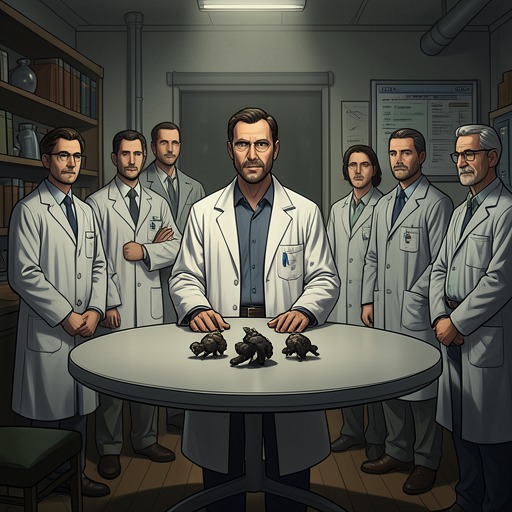
You are God!
How to Change Your Mind“You are God!” is the charged center of Timothy Leary’s recollection of his first psilocybin experience: not merely a description of what he believed he had learned, but a command to awaken and seek revelation. Spoken in a prophetic passage after his 1960 journey in Cuernavaca, the phrase turns a private encounter with altered consciousness into an invitation—and an imperative—addressed to everyone.
Origin and Rhetorical Turn
Leary first took psilocybin poolside in Mexico in the summer of 1960, three years after R. Gordon Wasson’s Life magazine article about mushrooms that caused strange visions. The experience, as Leary later described it, reignited his interest in the human mind with startling force. In Flashbacks, he contrasted four hours by the pool with the preceding fifteen years of diligent psychology, and recalled concluding that ordinary consciousness was only a small part of a much wider range of intelligence.
In High Priest, Leary remembered returning with an irresistible urge to “rush back and tell everyone.” The book’s account then changes register: instead of continuing as a report of discovery, it becomes an address to an imagined audience. “Listen! Wake up! You are God!” is followed by an assurance that divine purpose lies within the listener and an appeal to take the sacrament and receive a revelation that will change a life. The expression’s force comes partly from its abruptness. A claim about consciousness becomes a direct summons, with the listener cast not as an observer of Leary’s experience but as its potential participant.
From Experience to Exhortation
The passage presents the phrase as a hinge between Leary’s own experience and the public course that followed. The narrator describes the prophetic voice as one in which Leary’s future trajectory could already be foreseen. The declaration does not simply report that the drug altered his perception; it turns that alteration into a message, linking spiritual authority to personal transformation and urging others toward the same kind of discovery.
That rhetoric sits beside, but is not identical to, Leary’s early academic work. Back in Cambridge that fall, he recruited Richard Alpert, and the two launched the Harvard Psilocybin Project with the tacit approval of department chair David McClelland. Their office was a tiny broom closet in the Department of Social Relations at 5 Divinity Avenue. Leary presented the research as belonging to the tradition of William James’s study of altered states and mystical experience. Harvard permitted the drugs to be given to graduate students, but not undergraduates. The contrast is telling: the project operated within an academic framework, while “You are God!” speaks in the expansive, revelatory language that would reach beyond one.
Language, Guidance, and Containment
Later accounts in the book place that sweeping invitation alongside more structured ways of approaching psychedelic experience. A draft charter for a community of guides sought to make profound experiences more available, describing aims such as unitive and non-dual consciousness and identifying meditation, breathwork, fasting, and psychoactive substances as possible means. Its ethical code emphasized informed consent, confidentiality, safety, disclosure of risks, and protection against a guide’s self-promotion or ambition. A separate set of guidelines addressed preparation, intentions, drug interactions, frightening experiences, and post-session integration. This material does not repeat Leary’s declaration; it shows a later effort to surround powerful experiences with practices and responsibilities that his prophetic address leaves unstated.
The difference is also visible in the instructions given to Patrick before his clinical trial. Tony Bossis described a sequence of preparatory sessions and two dosing days: one with high-dose niacin as an active placebo, the other with twenty-five milligrams of psilocybin. Patrick would lie on a couch wearing eyeshades, listen to a carefully selected playlist, and have two sitters present. Bossis offered the concise mantra “Trust and let go,” and advised Patrick to approach rather than flee whatever seemed threatening. Here, language guides a participant through a bounded session; Leary’s phrase instead expands outward, making a universal claim and urging action.
The book’s account of a later ayahuasca circle offers another contrast in form. A dozen strangers gathered with an experienced guide for a ceremony involving traditional songs, prayers and invocations, bells, rattles, and scented smoke, even though the gathering took place in a yoga studio far from the jungle. Against such carefully staged settings, “You are God!” remains strikingly uncontained: a few words that collapse the distance between revelation and proclamation, and between the person who has undergone an experience and the audience being urged to seek one.